


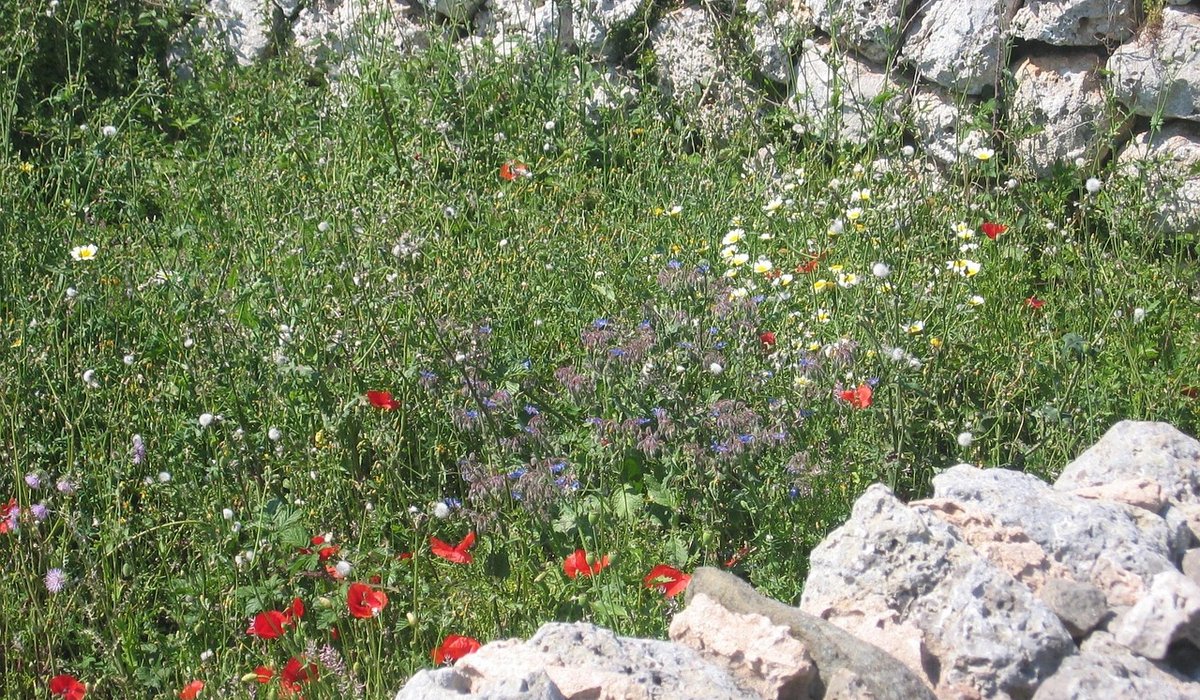
Why Local Stone Belongs In A Cottage Garden
Cottage gardens were never designed so much as accumulated. A flagstone path here, a low wall there, a few steps up to the vegetable bed — each piece added when time and materials allowed. What gave those gardens their quiet coherence was that almost everything was quarried within a day's cart ride. The stone in the wall matched the stone in the church tower and the stone in the farmhouse kitchen floor, because it had all come out of the same seam.
That logic still holds. Sourcing stone from a nearby quarry means your new wall, path or patio will share the same colour, grain and weathering pattern as the buildings around it. It also cuts the carbon cost of transport, which for stone is considerable: a cubic metre of limestone or sandstone weighs well over two tonnes, and every mile of that weight is paid for in fuel. A tonne of stone shifted twenty miles instead of two hundred makes a genuine difference, and it is one of the easiest environmental choices available in a landscaping project.
Read What Is Already Under Your Feet
Before ordering anything, look at the local vernacular. In the Cotswolds you are working with oolitic limestone in honey and cream. In the Pennines, millstone grit and grey sandstone. Kent and Sussex offer ragstone and flint; Devon and Cornwall, granite and slate; Northamptonshire, ironstone in warm rusts. Even within a single county the colour shifts from pit to pit, so the most useful thing you can do is handle samples.
Walk the village and note:
- The stone used in boundary walls, barns and older houses, and how it has weathered.
- Whether the local tradition is coursed rubble, squared blocks, flint panels or dry stone.
- What the mortar looks like — most old walls use lime, not cement, and it shows in the softness of the joints.
- Any reclaimed stone available locally, which will already carry the patina and lichen that new stone takes years to acquire.
Matching The Material To The Feature
Different features call for different formats, and a local quarry will usually supply most of them. A few practical pairings:
- Walls: coursed rubble or squared stone for a traditional look, laid with lime mortar. Ask for a mix of sizes rather than uniform blocks, which read as modern.
- Paths and patios: flagstones or riven paving with a natural, slightly uneven face. Avoid sawn-and-polished finishes in a cottage setting; they look out of place within a season.
- Steps: solid stone treads rather than thin slabs, with a subtle chamfer or bullnose to the front edge. Local stone grips better underfoot when wet than many manufactured alternatives.
- Edging and kerbs: setts or upright stones to hold gravel in place, especially where a path curves.
- Dry stone: where the local tradition exists, a dry stone wall needs no mortar at all and provides invaluable habitat for insects, toads and solitary bees.
Getting The Details Right
Local stone is only as good as the way it is laid. A few specifics worth insisting on with your stonemason:
- Use a lime mortar — typically a natural hydraulic lime mixed with sharp sand — for any stone wall, particularly with softer limestones and sandstones. Cement traps moisture and can spall the face off a stone within a few winters.
- Set wall footings below the frost line, usually around 300mm for a garden wall, on a compacted sub-base.
- Give paving a fall of roughly 1:60 to 1:80 away from buildings, and allow for drainage at the low edge.
- Keep step risers consistent at about 150mm, with treads of 300mm or more — irregular steps are the most common complaint about stone garden work.
- Point with a recessed or brushed joint rather than a raised bead, so water runs off rather than sitting against the stone.
Sourcing Sensibly From A Local Quarry
A phone call to a quarry within thirty or forty miles is usually more productive than scrolling through national supplier catalogues. Ask what they have in seconds, rejects or oversize — stone that is sound but not dimensionally perfect is ideal for garden walls, rockery and rustic paving, and it often costs a fraction of the best grade.
When ordering, work out quantities by volume rather than by eye: a cubic metre of built wall swallows roughly two tonnes of stone, and a 50mm-thick flagstone covers about twenty square metres per cubic metre. Add ten per cent for cutting and breakage. Check delivery access too — a tipper lorry needs a hard, wide approach, and stone is usually dropped on the nearest solid ground rather than carried round the back.
Let It Weather Into The Garden
New stone always looks a little raw. That passes. Within a year or two, lichens will find the surface, moss will settle into the joints, and the colour will settle into something closer to the buildings you were trying to echo.
You can help it along. Plant alpines, thyme, campanula and ferns into wall crevices, and let self-seeders such as alchemilla and eryngium spill over path edges. Avoid pressure-washing stone, which strips the surface and encourages erosion. A stiff brush and a little patience will do far more for a cottage garden than any amount of cleaning. Choose local stone, lay it well, and the garden will look as though it has always been there.


Leave a reply